
TEATIME with El Bailey.
Deep dive in the world of motion design with El Bailey, motion designer and illustrator and member of the Tone Def. collective. We talked finding balance in a world of inspiration overload, creative discipline, collaboration insights, and the future of storytelling.
Happy reading!
M. Hey El! How are things on this bright Monday?
E. I’m okay, enjoying a focused start of the week before things get heated!
M. Good stuff, we’re really happy to get to chat today. We’re going to go through all things from creative inspiration to the future of storytelling. Are you ready?
E. Let’s do this!
M. Let’s kick things off. What’s something that made you smile recently?
E. Pets! Recently, I’ve been taking a few illustration commissions, among them doing pet portraits. When people commission one of these they have to send me lots of pictures, so my inbox is just getting full of people’s cats, people just keep sending me pictures of their cats, showing them off, and some of them are just so silly looking, I had good laughs watching these blurry cats and reading the descriptions people send me, they’re really sweet to read through and work with. Some people just apologise for sending me too many pictures of their cats but they can’t help it, it’s really sweet, it’s been making me smile recently!
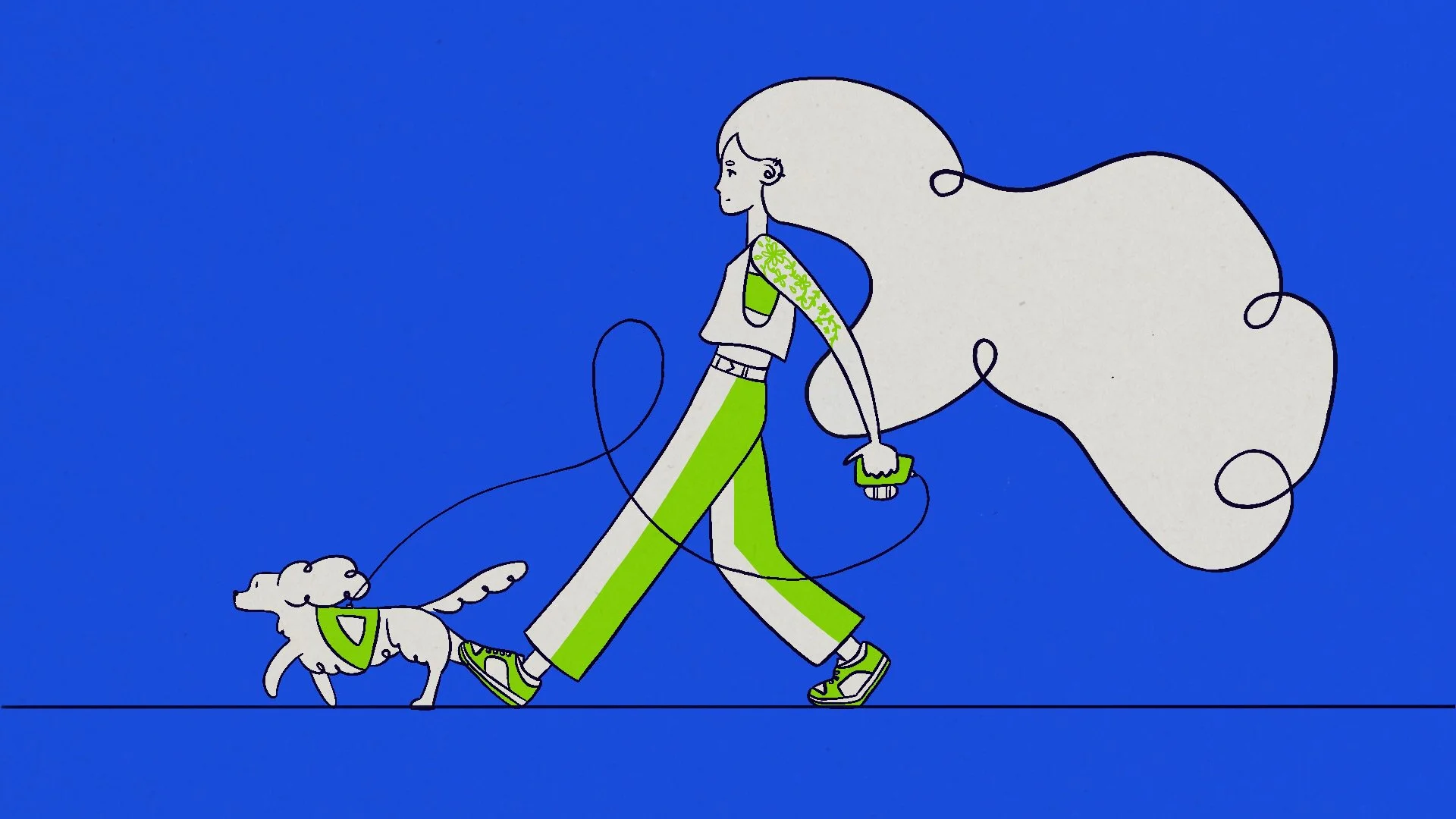
Illustration by El Bailey: a dogwalker
M. That sounds like the best possible gig!
E. Yes it’s something I want to build on, I find it really rewarding to capture their personalities… It’s been fun!
M. What’s currently on your playlist ?
E. God, so much stuff. I have a whole playlist of video game music. I often can’t listen to stuff with lyrics when I’m working because they just clog out my brain. So I have a playlist of videogames soundtracks, some from my favourites and some that people just recommended to me, and it’s now around 25 hours long or something (!).And I just put that on all the time, and it’s always good, a mixture of instrumental and atmospheric music.
M. That’s interesting, the first thing that comes to my mind when you mention video games music is like, Tetris vibes, very hyper, fast!
E. Some of it is fast, most of it is chill every now and again it music will come on like a boss battle, and it’s like, time to lock in, but most of it is chill music that I can have in the background, that kind of reminds me of games I enjoy… I listen to this playlist more than anything else.
M. I might give it a go to see how it works for me!
M. Alright, now I’d love to get into your creative world… the way you work, think, and find inspiration . Let’s go.
If your creative style had a personality, how would you describe it?
E. That’s tricky. I think one compliment I got was that what I drew felt like a hug, and I love the idea. I think that’s what I unconsciously go for, it’s a sense of warmth and friendliness, but also a little bit of weirdness. I like to add a bit of humour if I can. I try not to take it too seriously and I think that comes across, in a good natured way.
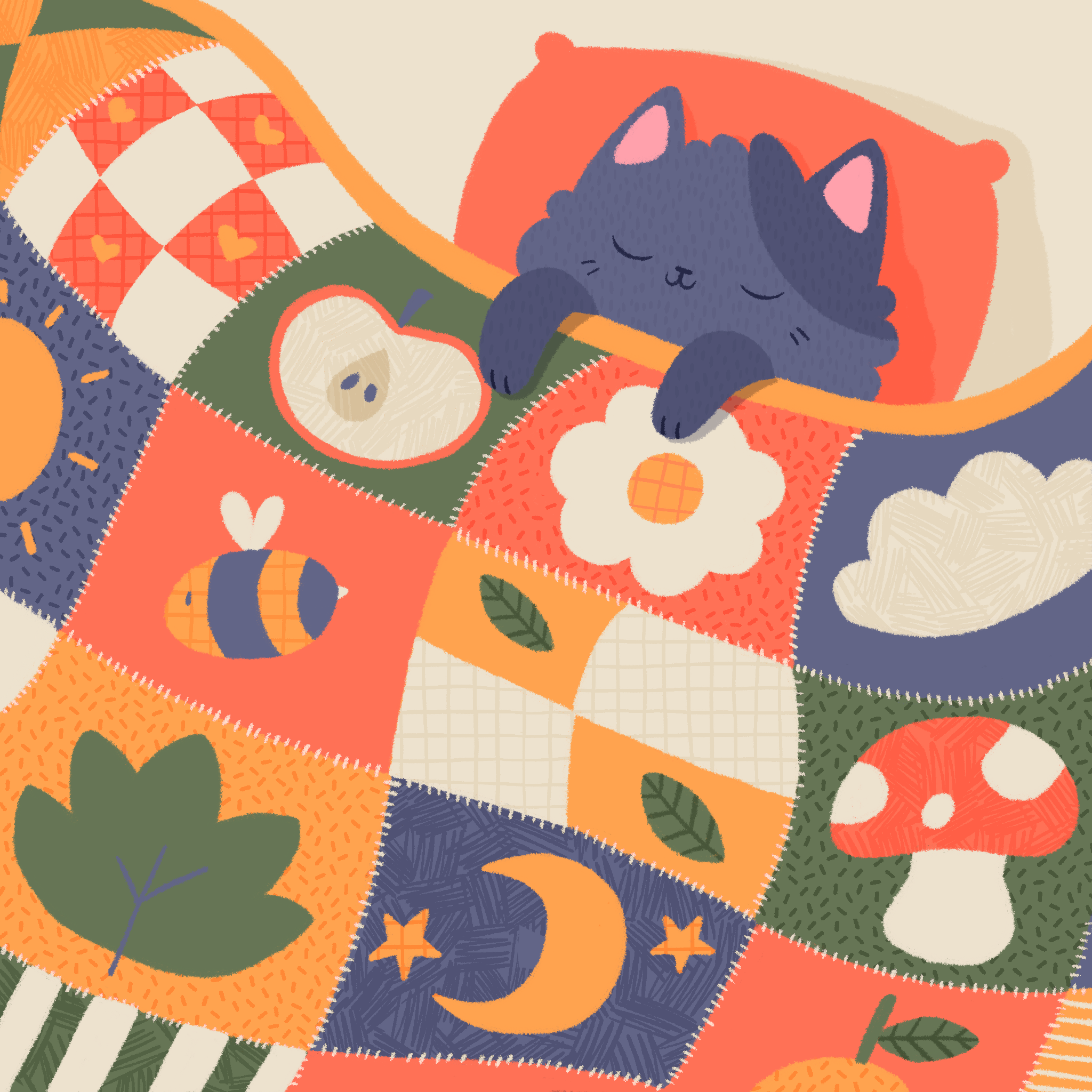
Illustration by El Bailey: ‘Quilt’
M. What’s the one thing you love the most about your practice?
E. I think it’s the surprises. I think a lot of creatives can relate to this. The things that you expect to work well, sometimes don’t. But it’s often the things that you don’t expect to go well, that just suddenly really land, and it’s always a surprise. Sometimes I make something and I think ‘this feels good’ and it works but it’s not that good, and sometimes I just do something that feels a bit uncertain, or I’m trying something new, and doesn’t feel great, but then it goes down really well, people really like it or I end up really liking it and it’s always surprising and can never be predicted, and I think I quite like that, because it feels like it’s not closed off.
I think the most exciting thing in a creative practice is when things end up working out, even when it felt they weren’t going to, just like in life.
M. Where do you seek your inspiration from? It may be design related or not.
E. I try to not get too obsessed with other animations or illustrations, because it’s great to seek inspiration from them, but sometimes it can end up feeling a bit like an echo chamber, as if everyone was watching the same short films and the same ads, the same TV shows… It’s nice to be part of that, but I feel like I get the best ideas when I take that inspiration on and then disconnect.
Getting out in nature and letting my mind clear, that’s when my brain digests everything. We’re taking so much information, sometimes you need to give your brain a little digestive period. It’s like sitting out after a long meal, and feeling… ‘ok, let me let that settle’. So when I feel stuck for ideas and inspiration, I stop trying to be inspired, and that’s when something normally comes up.
M. I love that, it’s a form of meditation, isn’t it? I sometimes wonder what’s the long term effects of us receiving so much information all the time. You feel like you can look at everything, but you can’t actually, and it’s not helpful.
E. Yes, it’s hard to remember the last time I was bored, when I was a kid I was bored all the time, and I was very creative. Now if someone asks me, when was the last time I was bored, I’ve got to really think about it. I’m never bored! So, I’m trying to get bored more often, to see what happens. But it’s hard to resist the temptation to pull out my phone!
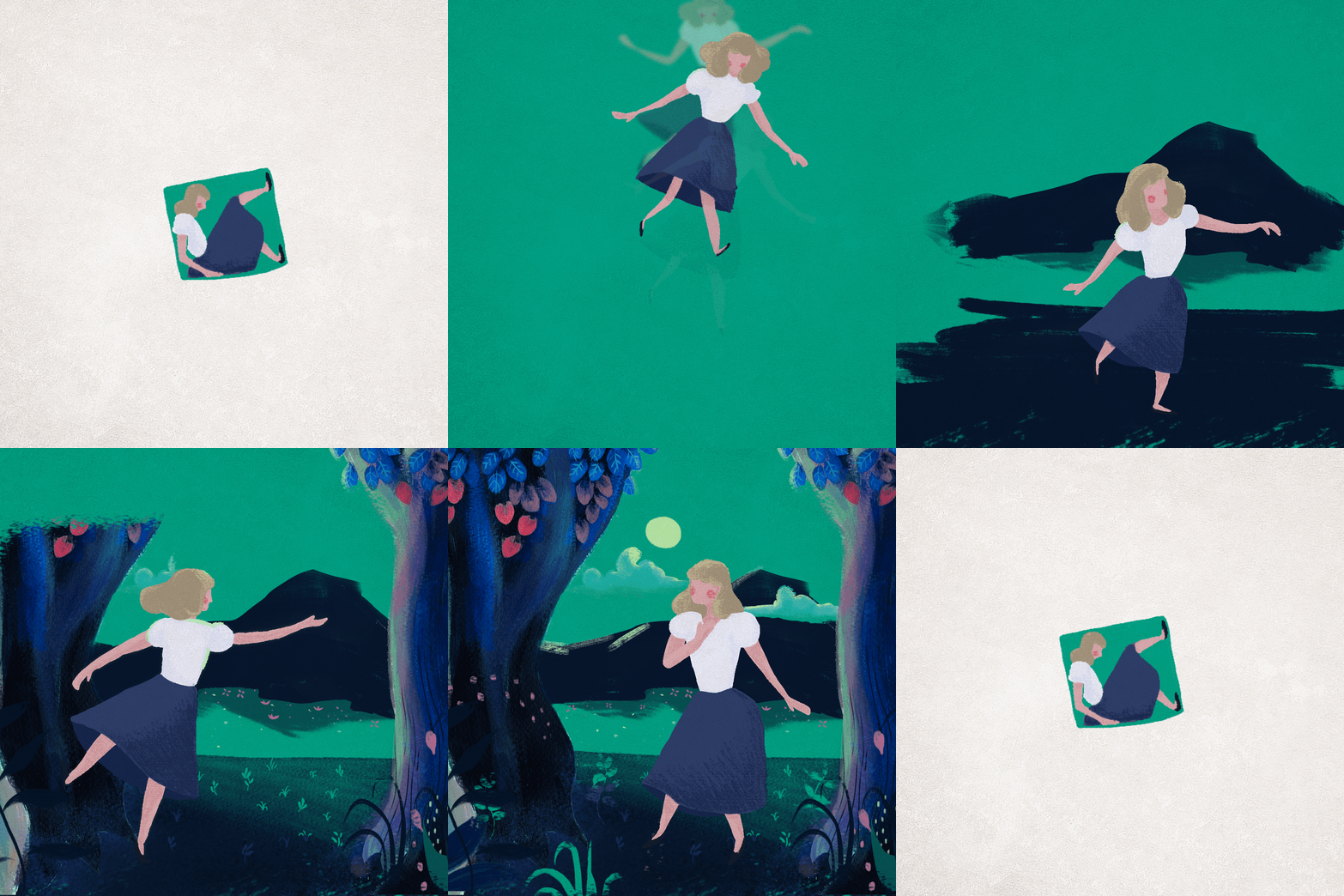
Animation by El Bailey for Nucco studio, International Women’s Day, 2019.
M. Do you have a ritual to ‘get in the zone’ creatively?
E. I don’t have a super strict routine. I try to get any admin out of the way first, any emails that need replying to, my daily Linkedin session needs to be done first thing, along with any little chords, otherwise they just sit in my head and annoy me. And then I have apps on my phone that block everything, so if I really try to focus I’ll just use one of these, to keep me off my phone, unless it’s an emergency call. And then my music! Beyond the video games one, I’ve got a few jazz, or classical music ones that put me in the right mood, and that’s kind of it.
M. I can relate about the blocking apps, but always end up bypassing them…
E. The one that really works for me is called Screenzen, and I have it blocking all social media during weekdays. But it does feel counter intuitive to download an app to stay off your phone.
I considered using an actual dumb phone, but as an entrepreneur you can’t really go without social media. I might be sitting waiting for an eye appointment, and receive a request for a really short term project, so I could potentially miss out if I closed everything off too much. It’s a balance. It’s a hard one to find. I’m working on it.
M. Let’s chat creative collaborations. What do you like the most about working independently, as opposed to working in a bigger creative team?
E. I like the ability to choose, to a certain extent, to be able to say no to certain projects that go against my values. It’s been great to establish these boundaries throughout my solo career. Creatively, I can go for the projects that are inspiring and make me excited, and I also enjoy the flexibility of being able to have my own schedule. On another hand working alone made me miss having a regular community, being part of a team. Joining a studio for a few weeks is a little bit sad: you get to know people and then leave. And the lack of stability is really hard. Learning to trust yourself and the process is a journey!
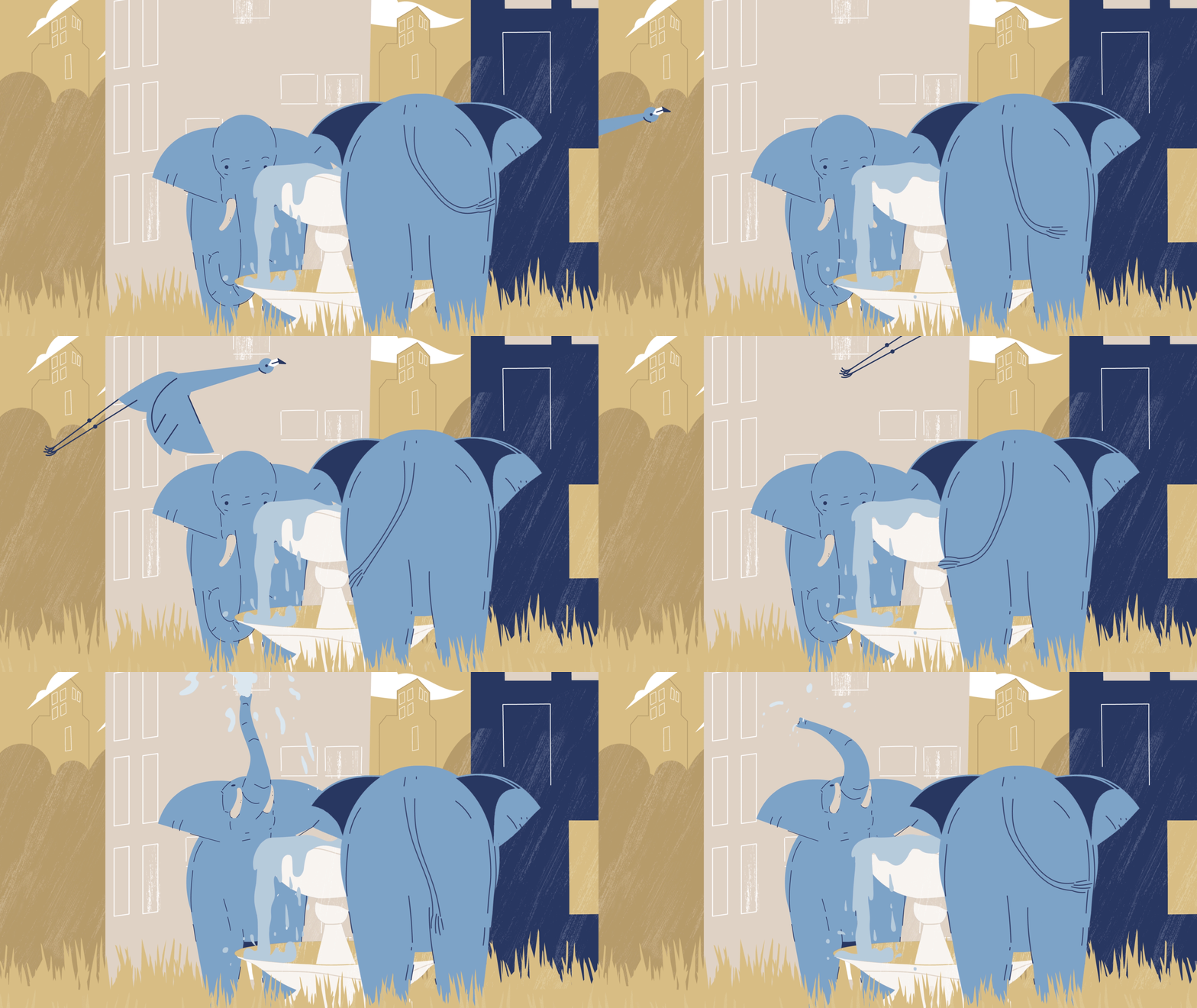
Animation by El Bailey for Dreamcloud, Nucco Studio
M. What matters to you the most in working with other creative partners?
E. Like most things, it comes down to communication for me. Communication can make or break a project. If the communication is good, we don’t need to 100% agree with each other, as long as everything has been communicated and we are on the same page.
It’s also about understanding each other’s role and position within the project. I always bring this up early on with partners, because if they can understand what I do and I understand what they do, then we’re less likely to get into conflict with each other. It’s about setting expectations. When you don’t have the chance to meet face to face, you’re missing out on so many emotional cues from each other, so you really need to elevate the communication.
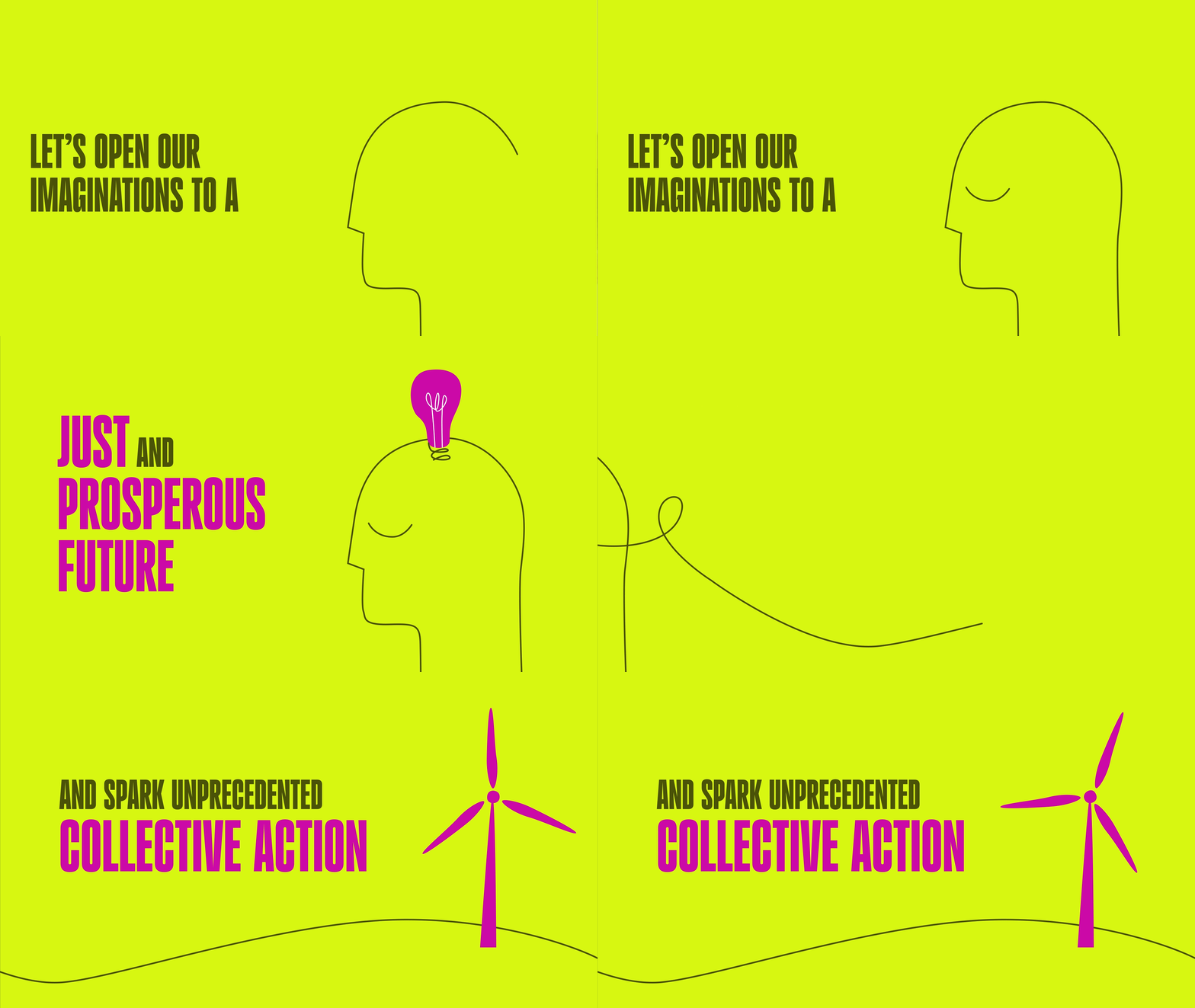
Animation by El Bailey for Climate Kic, at 89up
M. What do you enjoy most about collaborating with small client teams?
E. They’re often really excited about the project. I recently worked on a project where it was the client’s first video, and they were so enthusiastic about what we were creating, it really lifted me, the energy. I also think smaller teams are more open to new ideas, and are more open to express their own ideas too, because there is less heavy structure around them. And the process is faster. We can all work at pace and it feels good.
M. What unique challenges have you faced in these collaborations, and how have you overcome them?
E. Often, most projects I’ve worked on changed over the course of me working on them. It’s never the same as when you start, so that’s why again, communication is so important. And clearly stating the expectations in terms of deliverables (for the client) and time (on my end).
M. Let’s chat motion design and animation. What are the key added values that motion design can add to a campaign or any other messaging asset?
E. One of the reasons I really love motion design and animation is that you can take really big, complex ideas, and lay them in the most simple, accessible way. I think most design disciplines do that, but motion is really effective at it. It can also make ideas that may seem scary or complex, more digestible. Often, clients have really big ideas or stories they want to tell, and motion just helps distill them. It can make the message more playful, exciting, and make topics that may seem dry, really engaging to watch or look at.
M. What are specific aspects of motion design that clients should understand for a successful collaboration?
E. How long it takes. I have this conversation a lot. There seems to be this idea that you just press the animation button… and things animate! I think often people don’t fully understand what goes into good animation and motion design. It becomes a mysterious blackbox and things just come out of it. So I try to be really transparent about what I actually do and how long things take. I don’t want people to think that it’s a mystical process either! Yes there is skill involved, but it’s not a mystical form of magic either. You can understand what I’m doing. It requires pedagogy.

Animation by El Bailey for Bayer Healthcare, at Fleishman Hillard
M. What are your favourite types of animation/motion design projects?
E. I think it’s two categories:
The projects that are more creatively fulfilling, where I have a bit more freedom, where I can experiment, those are really fun.
The other type is projects that have a good cause, and to which I can relate on a different level. They might be more creatively simple but I get real satisfaction working on projects that have this positive outcome. They’re fulfilling from a values perspective. The dream is to do both at the same time of course!
M. To close this interview, I’m really curious to hear your perspective about the future of the storytelling industry, what makes you excited about, any trends you might see emerging?
E. Things are definitely changing right now, shifting faster than I’ve ever seen before, the whole industry feels like it’s very much in flux. But one thing that definitely makes me - if not excited- interested, is the fact that there is a conversation not just about what stories we’re telling but how we’re telling them, especially with the rise of generative AI, where people who are not designers or storytellers are taking part of this conversation. Do we want a machine to tell stories? It relates to the big questions: ‘what is design’, ‘what's art’, ‘what’s storytelling’? Is it the same if AI does it? There’s been a recent desire for specifically human made design because a lot of people are realising that they value that. And I think that’s a really interesting conversation to have. What tools are we using, what impact do they have not just on the design world but on society as a whole. People are being more aware of this than ever before.
My mum was a designer and she remembers when Photoshop and in-design changed her job forever. But that wasn’t really a discussion outside of the design world. It wasn’t in the news. Whereas with AI, even people outside of the design world have an opinion on it and how the stuff they are consuming is created, which I think is really important. I’ve never talked to people outside of my industry about, you know, After Effects, but now, even people I meet randomly have questions and opinions about what’s happening right now with AI. And I think that’s going to have a big impact on how we go forward as storytellers and designers. People aren’t mindlessly consuming, they’re questioning: ‘how is this made?’, ‘who’s making it?’ and ‘do I want to be a part of that?’
I think the conversations are getting exciting.
M- It seems there is a growing ‘cyber-punk’ approach to making design.
E- Yes I can definitely see that trend with software. Blender is open-source and has been around for sometime. The best animated picture from last year was made with Blender! There is a shift away from the big companies owning the design software, where people are seeking alternatives, which are much more accessible to younger people and a wider demographics. I could go on about the price of entry into a design career. I feel very passionately about that.
M. Definitely an exciting time for the storytelling world, and I’m equally excited to see what comes next! Thanks so much El, looking forward to our next chat!
E - It’s been fun, thank you!
